Every precision medicine breakthrough starts with the same question: which patients, which variants, which outcomes?
The science to answer it has never been stronger. Sequencing costs have collapsed, multi-omic assays are routine, and real-world evidence is finally available at scale. Yet many research teams still spend most of their time finding, cleaning and reconciling data rather than analyzing it.
The bottleneck in precision medicine isn't the biology. It's the plumbing.
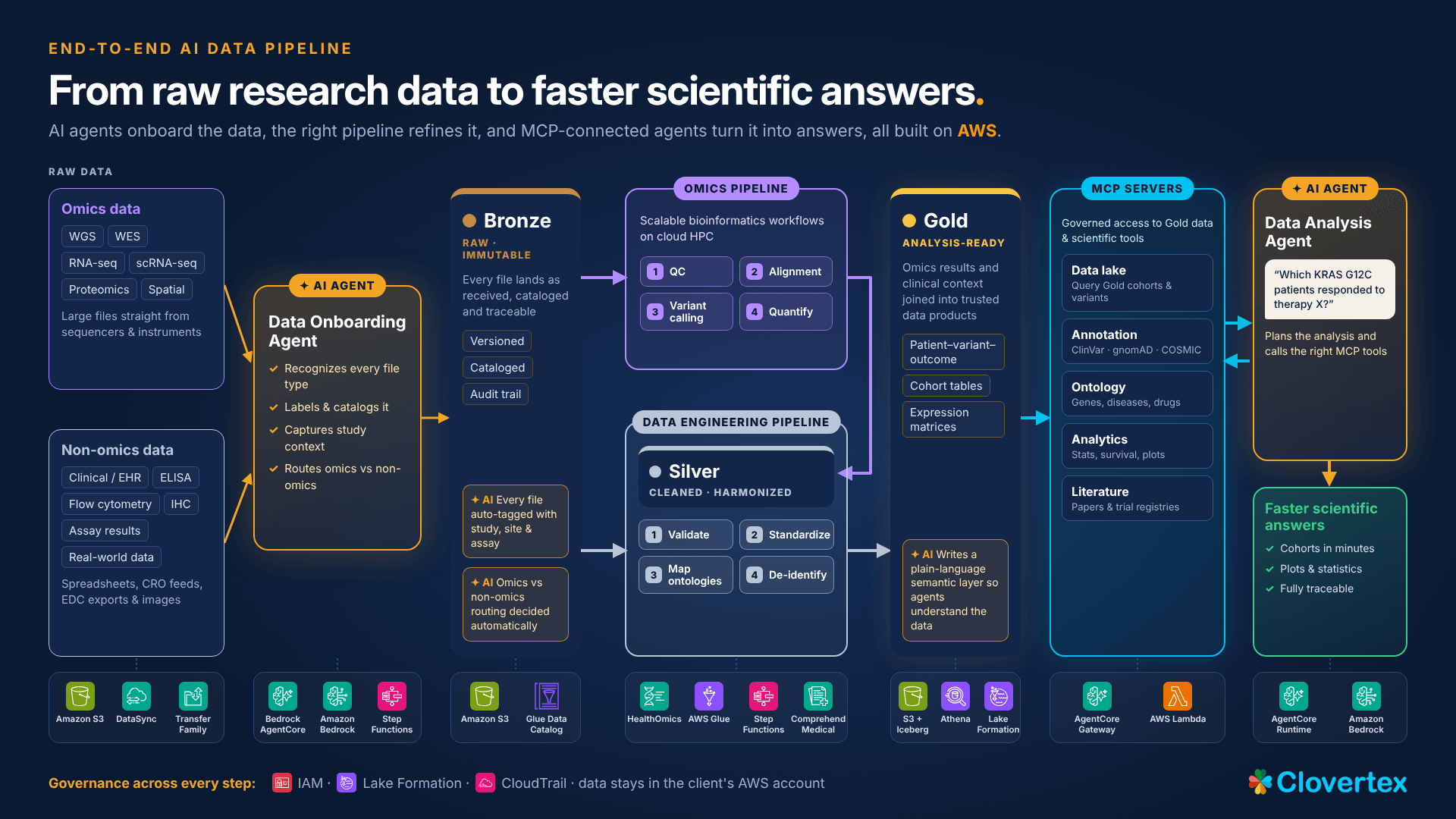
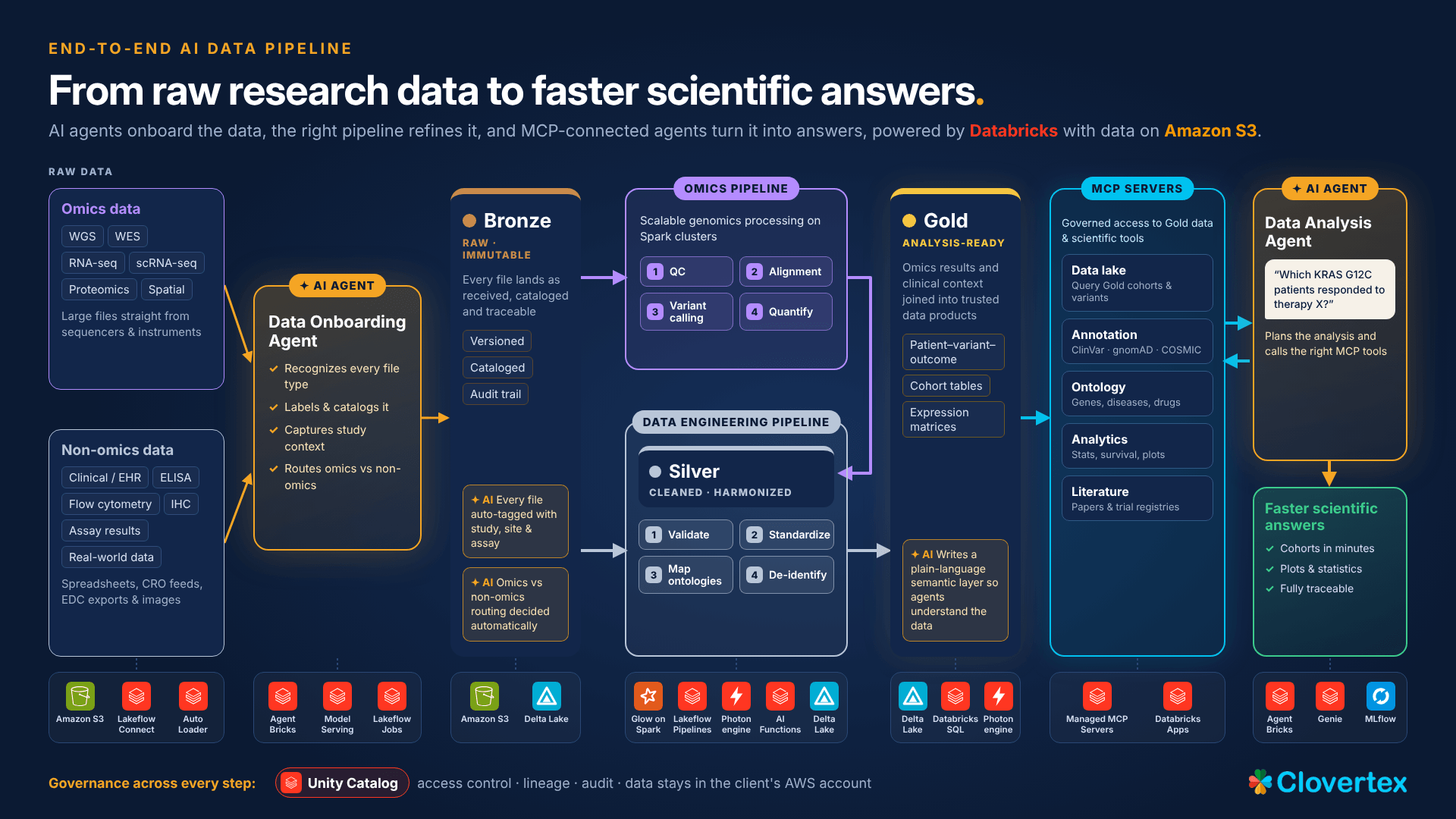
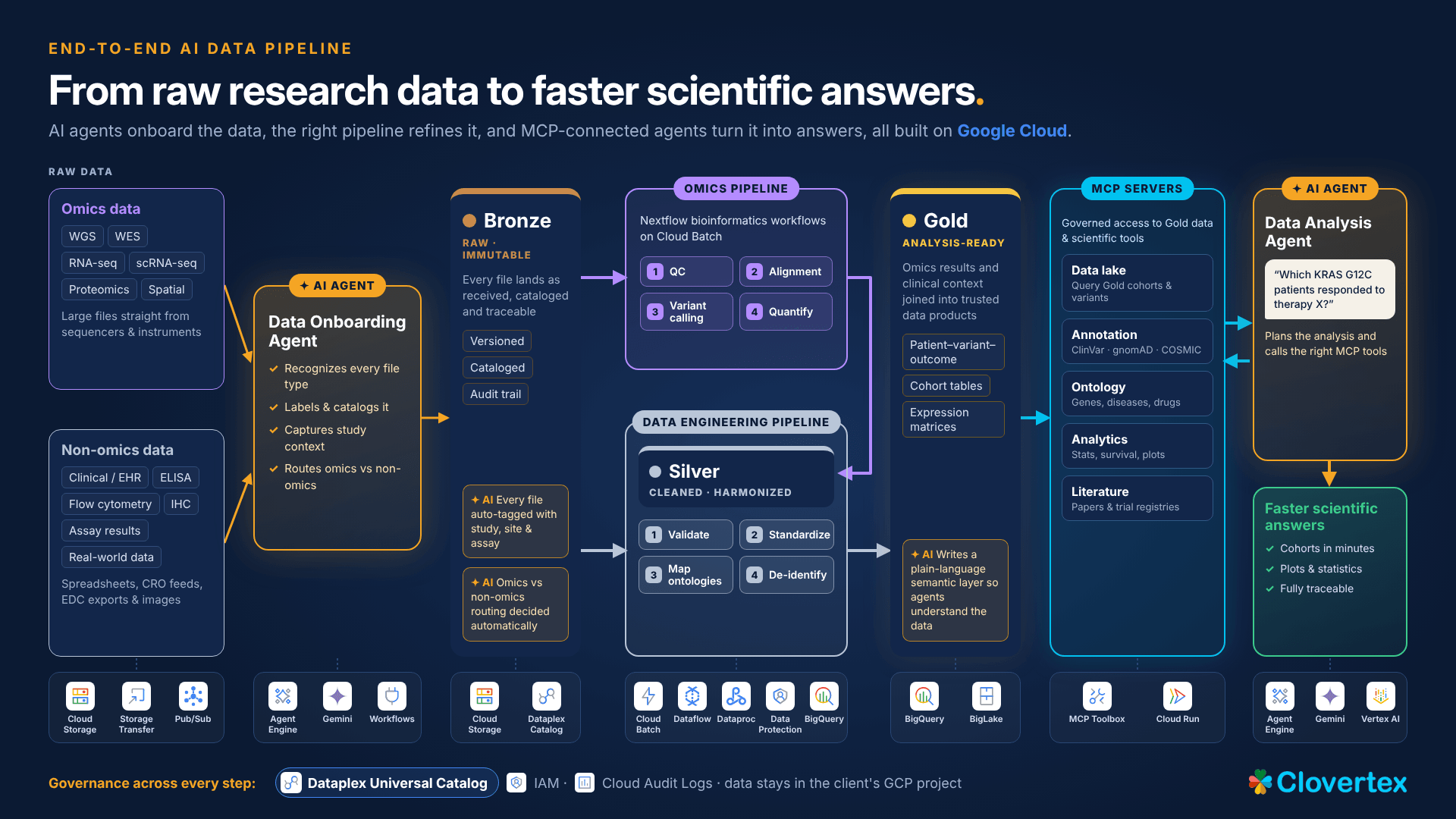
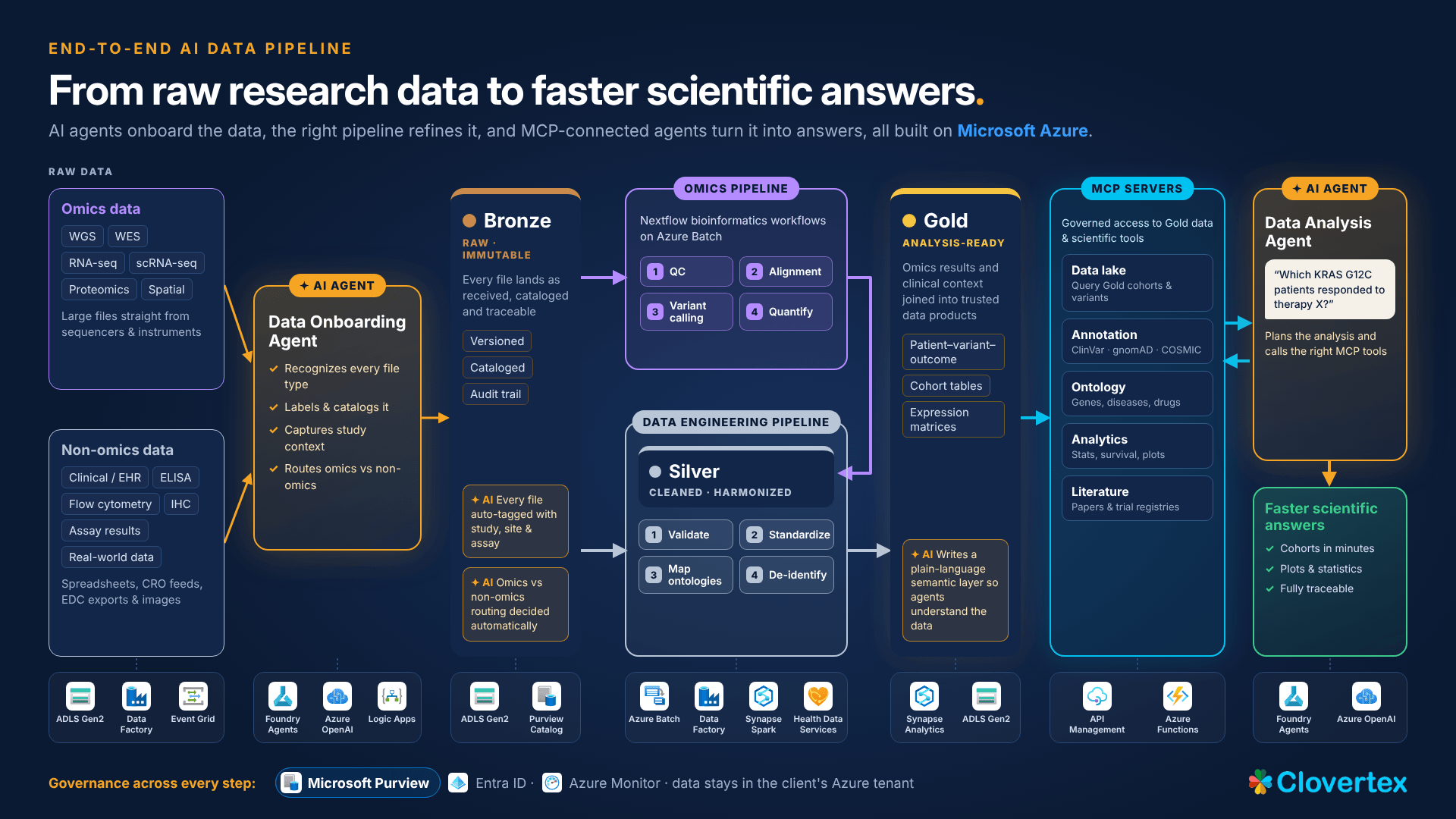
At Clovertex, we're working with leading pharma companies to fix that plumbing, using two complementary approaches: AI-driven data pipelines built on a medallion architecture, and MCP-driven analytics agents that let scientists interrogate that data in plain language.
The problemFragmented data, slow answers
A typical oncology research program might draw on:
- Whole-genome and exome sequencing (FASTQ, BAM, VCF)
- Clinical and EHR data from multiple trial sites
- Biomarker and assay results from CROs
- Real-world evidence and claims data
- Imaging, digital pathology, and increasingly single-cell, spatial and proteomic data
Each source arrives with its own formats, vocabularies and quirks. The same gene might be labeled three different ways. A "response" field might mean different things across studies. Critical metadata is often missing entirely.
The result is familiar to anyone in R&D informatics: weeks of data wrangling before every analysis, siloed datasets no one fully trusts, and bioinformatics teams buried under ad hoc requests.
Part 1AI-driven pipelines on a medallion architecture
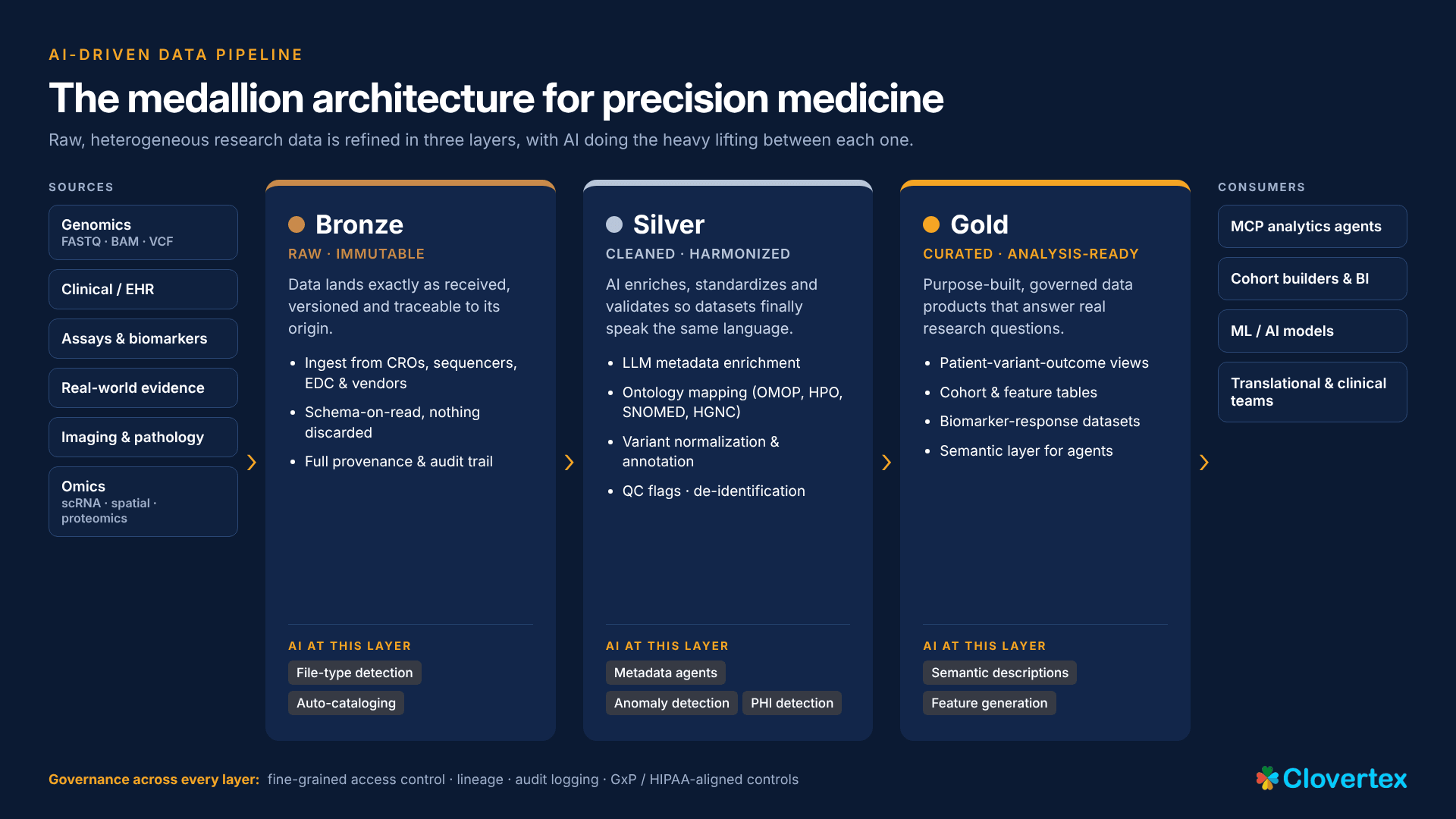
The medallion architecture is a proven pattern for organizing a data lake into progressively refined layers. What we've added is AI at every handoff, so the work that used to require armies of data curators happens automatically and consistently.
🥉 Bronze
Raw & immutableData lands exactly as received from sequencers, CROs, EDC systems and vendors. Nothing is discarded or altered, and every file is versioned and traceable to its origin. AI helps here by automatically detecting file types and cataloging incoming data, so nothing disappears into an unlabeled S3 bucket.
🥈 Silver
Cleaned & harmonizedThis is where AI does the heaviest lifting. Metadata enrichment agents read file headers, sample sheets and study documents to fill in missing context. Study-specific fields are mapped to standard ontologies such as OMOP, HPO, SNOMED and HGNC. Variants are normalized and annotated. Anomaly detection flags QC issues, and PHI detection supports de-identification before data moves downstream. Disparate datasets finally speak the same language.
🥇 Gold
Curated & analysis-readyThe Gold layer holds purpose-built, governed data products: patient–variant–outcome views, cohort and feature tables, and biomarker–response datasets. Crucially, it also includes a semantic layer, meaning plain-language descriptions of every table and field. That layer is what makes the next step possible.
Governance at every layer
Governance runs through all three layers: fine-grained access control, end-to-end lineage, audit logging, and controls aligned with GxP and HIPAA requirements.
Part 2MCP-driven analytics agents
Clean data is only half the story. Even with a well-built Gold layer, most scientists still can't query it directly. They file a ticket, wait for a bioinformatician, and iterate over days.
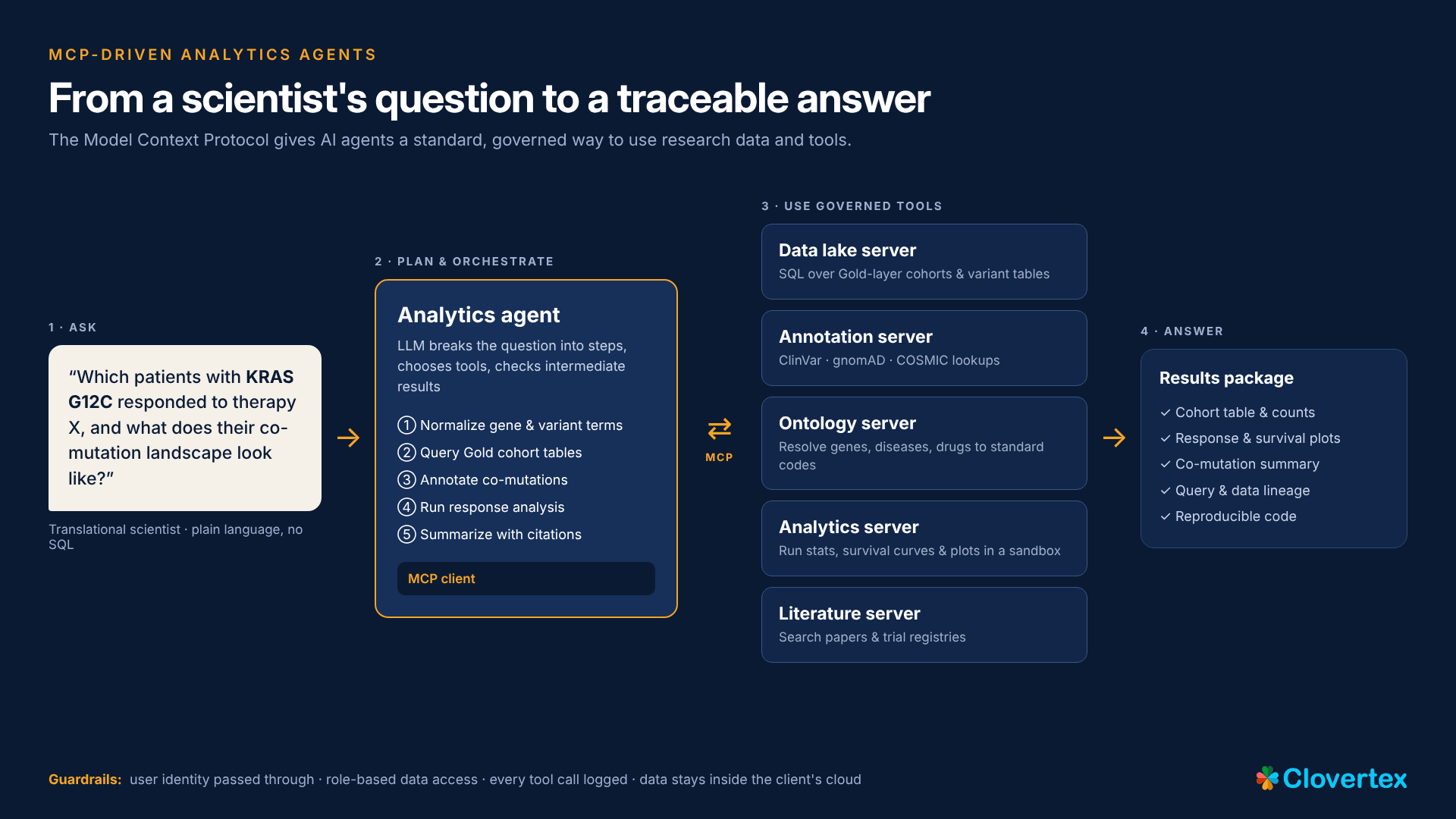
This is where the Model Context Protocol (MCP) comes in. MCP is an open standard that gives AI agents a consistent, secure way to connect to data sources and tools. Instead of building a fragile custom integration for each system, we expose capabilities as MCP servers:
Data lake server
Governed SQL access to Gold-layer cohorts and variant tables
Annotation server
Lookups against resources like ClinVar, gnomAD and COSMIC
Ontology server
Resolving genes, diseases and drugs to standard codes
Analytics server
Running statistics, survival analyses and plots in a sandbox
Literature server
Searching publications and trial registries
A translational scientist can now ask:
"Which patients with KRAS G12C responded to therapy X, and what does their co-mutation landscape look like?"
The agent breaks the question into steps, normalizes the gene and variant terms, queries the cohort tables, annotates co-mutations, runs the response analysis and returns a results package: cohort counts, plots, a co-mutation summary, and the full query lineage and code so every answer is reproducible.
Just as important is what the agent can't do. The user's identity is passed through to every tool, so the agent only sees data that person is authorized to see. Every tool call is logged. Data never leaves the client's own cloud environment.
The systemWhy the two belong together
An AI agent is only as good as the data it can reach. Point an agent at a raw, unharmonized data lake and you get confident-sounding answers built on inconsistent foundations. Pair it with a well-governed Gold layer and a rich semantic layer, and you get something genuinely useful: fast, accurate, auditable answers.
That's why we design these as one system.
The pipeline makes data trustworthy, and the agents make it accessible.
The outcomeWhat this unlocks
Faster cohort discovery
Questions answered in minutes, not weeks
More time for science
Bioinformaticians freed from repetitive requests to focus on hard problems
Trust by design
Lineage, access control and auditability built in, not bolted on
Future-ready foundations
New modalities like single-cell, spatial and proteomics slot into the same layered architecture
What's nextLooking ahead
AI in precision medicine isn't about replacing scientists. It's about removing the friction between a scientific question and its answer.
We're proud to be building this with some of the most innovative teams in pharma, and we're just getting started. Next on the horizon: multi-agent workflows that span discovery through clinical development, and richer multimodal analysis as new data types mature.
If your organization is wrestling with siloed research data, or exploring how agentic AI could accelerate R&D, I'd love to compare notes.