Most bioinformatics teams don't have a pipeline. They have a portfolio.
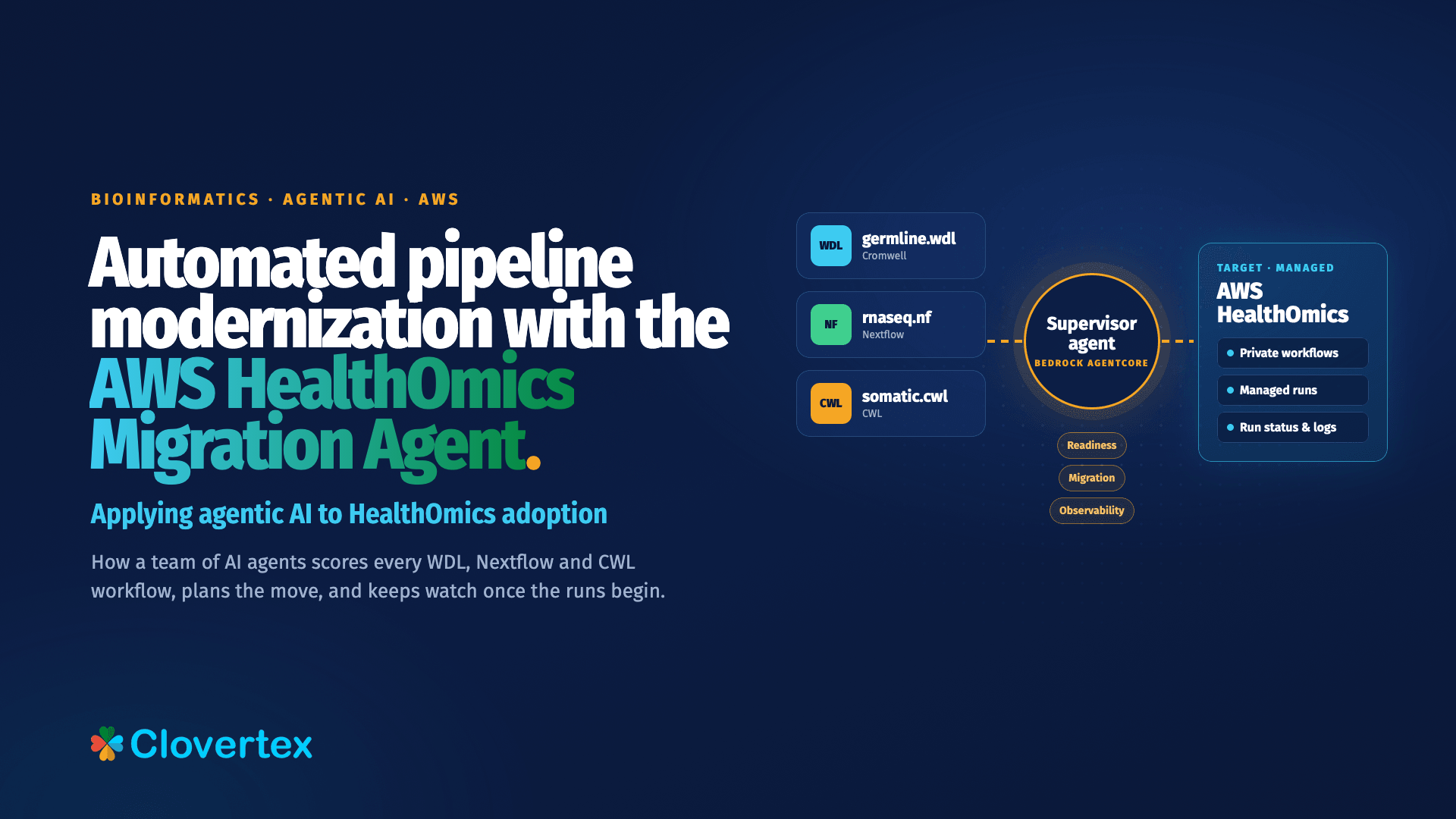
Germline calling in WDL on a Cromwell server someone set up years ago. RNA-seq in Nextflow on a shared HPC cluster. A somatic pipeline in CWL that only one person fully understands. Each one works, each one has its own quirks, and together they represent years of validated science that nobody wants to break.
AWS HealthOmics offers a better home for them. It runs private workflows written in WDL, Nextflow and CWL as a managed service, so teams stop maintaining workflow engines, schedulers and clusters, and just run their analyses. The destination is attractive. The question every team asks is: where do we start, and how do we get there without breaking anything?
Migrating one workflow is engineering. Migrating a portfolio is a prioritization problem.
At Clovertex, we built a multi-agent system to answer that question: AI agents that assess every workflow's readiness for AWS HealthOmics, plan and prepare the migration with a human approving each step, and keep watch once the runs begin.
The problemWhy workflow migrations stall
Moving a single pipeline to HealthOmics is usually manageable. Moving dozens is where teams get stuck, for familiar reasons:
- No clear starting point. Without knowing which workflows are easy and which are hard, teams either start with the wrong ones or spend weeks auditing before moving anything.
- Manual review doesn't scale. Every workflow needs an expert to read it, work out what has to change and decide whether it's worth moving now. That expert is usually the busiest person on the team.
- Inconsistent decisions. Different engineers make different calls about the same kind of problem, so the migrated portfolio ends up uneven.
- Regulated work needs a paper trail. In GxP and clinical settings, "we moved it and it seems fine" isn't enough. Every change and approval has to be traceable.
The approachOne supervisor, three specialist agents
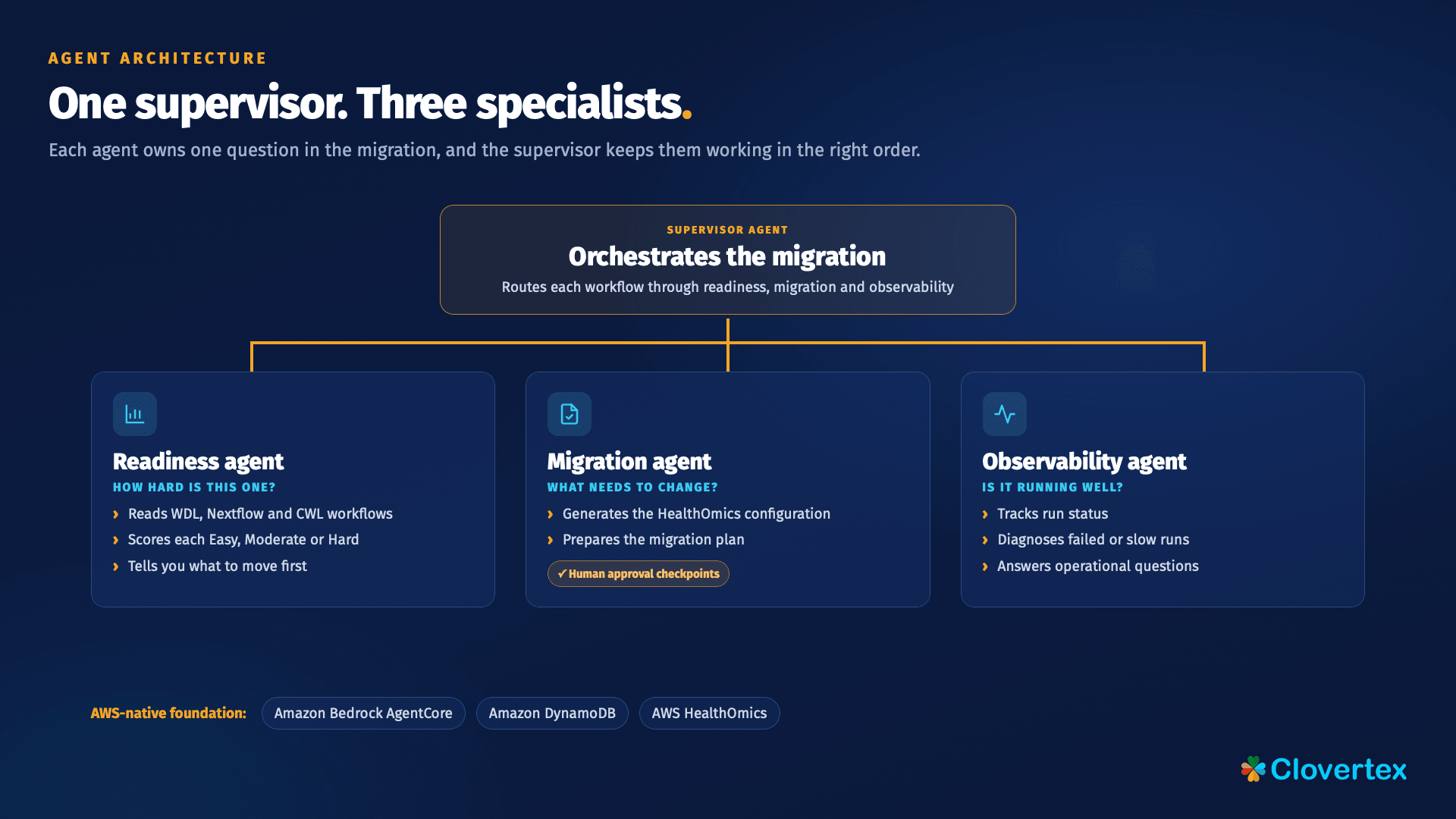
Rather than one general-purpose assistant, the platform splits the job into focused agents, each responsible for one question:
Supervisor agent
Orchestrates the others and routes each workflow through readiness, migration and observability in the right order.
Readiness agent
How hard is this one? Scores each workflow before any work begins.
Migration agent
What needs to change? Generates the HealthOmics configuration, with human approval checkpoints.
Observability agent
Is it running well? Tracks runs, diagnoses issues and answers operational questions.
The system is AWS-native, built on Amazon Bedrock AgentCore for running the agents and Amazon DynamoDB for keeping track of every workflow, score and decision.
Step 1 & 2Upload, then score every workflow
The journey starts simply: upload a workflow. WDL, Nextflow and CWL are all supported, matching the languages HealthOmics runs natively.
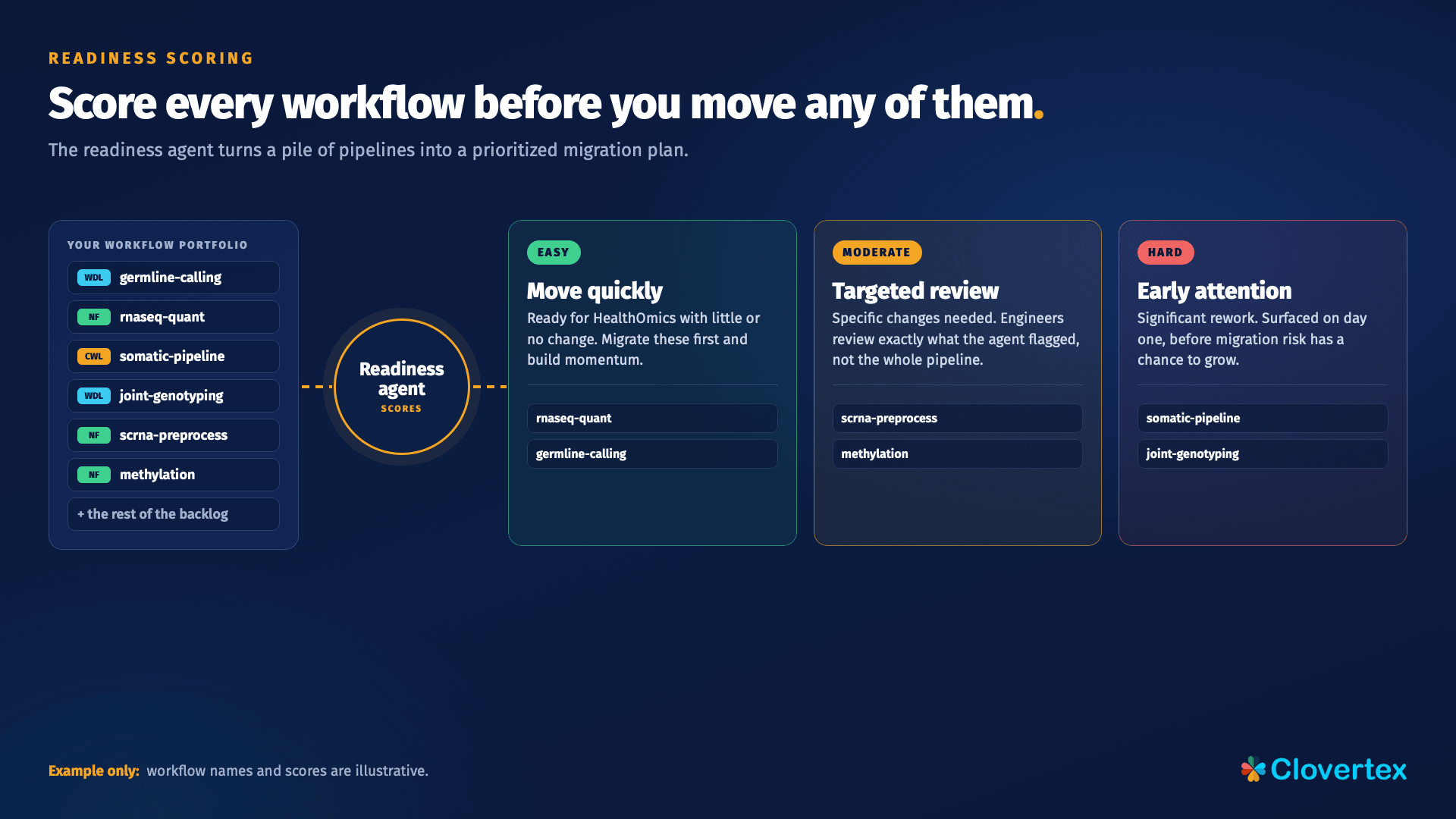
The readiness agent then scores each workflow as Easy, Moderate or Hard. That single label is what turns a daunting backlog into a plan:
Easy
Move quicklyReady for HealthOmics with little or no change. Migrate these first, show early results and build momentum.
Moderate
Targeted reviewSpecific changes are needed. Engineers review exactly what was flagged rather than reading the whole pipeline from scratch.
Hard
Early attentionSignificant rework. These surface on day one, so they can be planned and resourced before migration risk has a chance to grow.
What usually separates easy from hard
In our experience, a workflow's difficulty comes down to practical questions. Are its container images available from Amazon ECR, as HealthOmics expects? Do its inputs live in Amazon S3 or HealthOmics storage? Does it rely on engine-specific configuration, local paths or a particular cluster setup? And are its CPU, memory and GPU requests clear enough to map onto managed compute?
Step 3A migration plan, with a human in the loop
Once a workflow is scored, the migration agent prepares what HealthOmics needs to run it, generating the HealthOmics configuration and a migration plan for review.
Crucially, nothing moves on autopilot. The plan includes human-in-the-loop approval checkpoints: a scientist or engineer reviews the proposed configuration and approves it before it's applied. The AI does the tedious translation work; people keep the decisions.
The AI does the tedious translation. People keep the decisions.
Because every score, plan and approval is recorded, the result is a migration you can explain later, which matters as much to a QA reviewer as it does to the engineer who inherits the pipeline.
Step 4Observability after the runs begin
Most migration tools stop once the workflow is deployed. That's exactly when the real questions start: Did the run succeed? Why did this one fail? Is it slower than it was on the old cluster?
The observability agent stays on the job after migration. It tracks run status, diagnoses issues when runs fail or misbehave, and answers operational questions in plain language, so teams aren't left digging through logs to understand what happened.
The whole journeyUpload. Score. Plan. Observe.
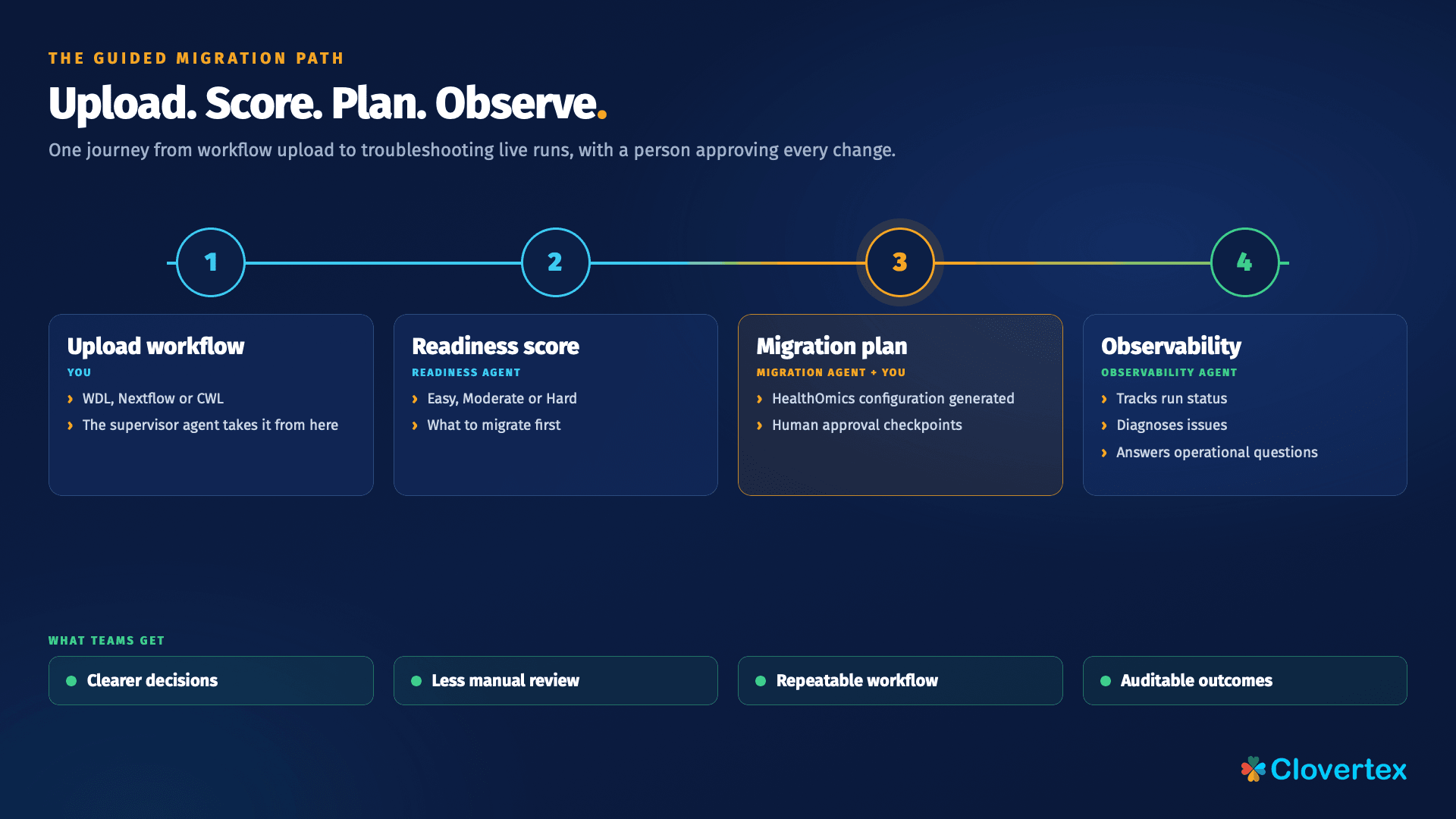
Put together, the four steps form one guided path, and the benefits compound across a portfolio:
Clearer decisions
Every workflow has a readiness score, so the order of work is obvious and defensible.
Less manual review
Experts review what the agents flag, not every line of every pipeline.
Repeatable workflow
The same process applies to the tenth workflow as to the first, so decisions stay consistent.
Auditable outcomes
Scores, plans and approvals are all recorded: traceability for regulated scientific work.
What's nextControlled automation for regulated science
The promise of agentic AI in life sciences isn't removing people from the process. It's removing the busywork that keeps skilled people from the decisions only they can make.
For workflow migration, that means agents that read, score, translate and monitor, while scientists and engineers prioritize, approve and stay accountable. Teams move faster, and they keep the approvals, traceability and run-level visibility that regulated scientific work demands.
If your team is weighing a move to AWS HealthOmics, or has a backlog of WDL, Nextflow and CWL pipelines and no clear place to start, we'd be glad to show you how the agents score your workflows.